I get e-mail from fellow Neoprobe longs and Blog readers, asking about the differences between Neoprobe's two radiodiagnostics. There is some confusion out there…
(Forward Looking Disclosure: I’m not in the medical industry. However, I’ve spent hours studying Neoprobe and its drugs, poring through countless data, clinical studies and physicians peer reviews, doing my best to interpret Doctorese into English. So, I’m gonna share my opinion of RIGS and Lymphoseek like I know what I’m talking about…)
First; even though RIGS and Lymphoseek are both radiolabeled tracers, they're not the same. In fact they’re very different.
Biggest difference: RIGS is designed to find cancerous tissue. Lymphoseek is designed to determine if cancer has spread.
RIGS actually locates cancerous tumor, helping to insure the removal of all the cancerous tissue by the surgeon. The patient is given an injection of the RIGS compound the day prior to surgery, which contains a low-level gamma I-125 radiolabel. The compound then circulates through the bloodstream. During this circulation RIGS locates and binds to all tumor tissue, including pre-cancerous tissue not readily discernible by traditional methods.
Surgeons currently use sight and feel to locate cancerous or suspect tissue for removal. However, tissue in early stages of metastases can display little or no outward evidence of its condition. RIGS binds to all cancerous tissue, including pre-cancerous and early cancerous tissue that otherwise may appear normal and may not have been surgically removed. During surgery, a Gamma detection probe is used to scan the patient. Any tissue containing the RIGS compound will alert and direct the surgeon to the exact location.
Remember... the most important question patients ask after surgery: “Did you get it all?”. RIGS helps insure they DO get it all.
On the other hand, Lymphoseek doesn’t actually find cancerous tissue. It finds lymph nodes located in the path of spreading cancer. This helps determine if cancer has spread from a malignant tumor, allowing the physician to determine the extent of disease progression, and subsequently design the most effective treatment.
Lymphoseek determines the spread of cancer by locating the Sentinel Lymph Node. Lymphoseek is injected near the cancerous tumor. It then migrates through the lymphatic system where it binds to the nearest (Sentinel) lymph node. The surgeon then tracks Lymphoseek's radioactive signature with the aid of a Gamma Guided probe to locate that Sentinel Node. The node is then surgically removed and biopsied to determine if cancer is present. The status of the Sentinel Node (cancerous or cancer-free) has proven to be highly predictive of the spread of cancer.
The human body has hundreds of lymph nodes which are an integral part of the body’s immune system. The lymph nodes are grouped into a number of “lymphatic basins”.
Should a cancer tumor become malignant and subsequently spread, that spread of cancer cells would most likely occur through the lymphatic drainage system within that basin. The first lymph node the cancer would reach within that lymphatic basin is designated as the Sentinel Lymph Node.
Locating and analyzing that Sentinel Node for the presence of cancer is called Sentinel Lymph Node Biopsy (SLNB). This method is emerging as the standard of care for patients of certain types of cancer, because of its high degree of accuracy.
In years past, the traditional approach was to remove ALL of the lymph nodes in the affected nodal basin. However, this approach removes between 10 and 30 lymph nodes from the patient, diminishing their immune system and causing unnecessary pain and long-term disfigurement.
The use of SLNB has proven to be equally effective at determining whether the cancer has spread, while being much less intrusive and physically challenging for the patient.
Currently, SLNB surgery uses a Colloid-based radiotracer that’s being used off-label. It was designed and approved in the 1950’s for use in internal surgery, but was never approved by the FDA for use in SLNB. There are numerous shortcomings associated with this current tracer, which Lymphoseek was designed to overcome.
The ideal Lymphatic radiotracer would have a number of desirable characteristics. These include fast injection site clearance, consistent lymph node binding with a low pass-through factor, and a short radioactive half-life. Lymphoseek demonstrates all of these, using a consistently-sized molecule specifically designed with binding characteristics targeted for lymphatic tissue. It’s the first radiotracer designed specifically for use as a Sentinel Lymph Node tracer.
In pre-clinical and FDA clinical trials to date, Lymphoseek has demonstrated superior site clearance, clearing the injection site between four and eight times faster than the older Sulpher colloid products. Lymphoseek begins clearing as quickly as 15 minutes after injection, saving time in the operating room. In a direct comparison in clinical trials, five hours after injection 95% of the Sulpher Colloid based product still remained at the injection site, whereas 75% of Lymphoseek had cleared the site and migrated into the lymphatics.
Statistically, the nodal binding characteristics of Lymphoseek and the current Sulphur colloid products are not substantially different. Lymphoseek was incrementally more accurate, with a mean number of identified nodes at 1.3 nodes per patient, and the Sulphur colloid product yielding 1.6 nodes per patient. In Phase I FDA clinical testing, Lymphoseek was 100% accurate in identifying the Sentinel Node. In Phase II clinical testing Lymphoseek was 99.5% accurate. In Phase III clinical testing (Breast & Melanoma) audited results confirmed 97% accuracy.
Radioactive half-life is also a consideration, balancing the length of the surgical window against the health issues associated with introducing radioactive elements into the patient. Lymphoseek demonstrated an advantage over the Sulphur colloid in this regard. Clinical tests revealed that Lymphoseek’s radioactive half-life was 3.23 +/- .47 hours. By contrast, Sulpher colloid’s radioactive half-life was 15.4 +/- 5.10 hours, necessitated by its relatively slow injection site clearance and the need for an extended surgical window.
Lymphoseek trials have revealed several other advantages. Due to its PH-balanced compound, Lymphoseek is a painless injection and the patient does not experience the burning sensation typical of the Sulpher-based products. Additionally, surgeons are reporting that the more rapid site clearance of Lymphoseek is resulting in faster surgery, saving time and money for the physician, staff and support facilities.
The current Sulpher colloid was initially priced at $150 per patient dose (per Dr. Anne Wallace, UCSD – 2003). In late 2009 the major supply reactor for Tc99m in North America (Chalk River facility) closed down, resulting in a price increase to $275 for Sulpher colloid (as of Q1-2010). In all of its current sales projections Lymphoseek pricing is based on $150 per dose, although there is an argument that Lymphoseek should be similarly priced to Sulpher colloid at the time of commercialization. In fact Lymphoseek could even command a premium due to its superior performance and the fact that it will be a First in Class tracer and the only one approved by the FDA for use in SLNB.
Lastly, once approved by the FDA, Lymphoseek is expected to receive a reimbursement code, allowing the drug to be reimbursed by Medicare, Medicaid and the larger insurance providers. The current Sulpher colloid product, not being FDA-approved, does not qualify for reimbursement. Being reimbursable should give Lymphoseek an additional financial advantage over the older tracers.
Now you know the difference between RIGS and Lymphoseek. You’re better off than I was when I got here. It took me a week of reading to sort it out. You get it in 5 minutes. I wish I were you.
DDbuyer
Oh… this is the technical description of Lymphoseek, for those of you who wish to start deciphering on your own:
Lymphoseek is a new radiopharmaceutical that accumulates in lymphatic tissues by binding to a receptor that resides on the surface of macrophage cells. The receptor, a mannose-binding protein, recognizes and binds macromolecules with carbohydrate side-chains that terminate with a mannose glycoside. Lymphoseek, previously 99mTc-diethylenetriamine pentaacetic acid (DTPA)-mannosyl-dextran, is composed of a dextran backbone to which multiple units of mannose and DTPA are synthetically attached. The dextran, having a molecular weight of 10,000 g/mol, satisfies the receptor’s requirement for a macromolecule. The mannose units are substrates for receptor recognition and binding. The DTPA units serve as attachment sites for labeling the macromolecule with 99mTc.
Showing posts with label cancer. Show all posts
Showing posts with label cancer. Show all posts
Friday, January 16, 2009
Tuesday, January 13, 2009
Obscurity and how to benefit from it
Definition: ob.scu.ri.ty
Show Spelled Pronunciation [uhb-skyoor-i-tee] Show IPA Pronunciation
–noun, plural -ties.
1. the state or quality of being obscure.
2. the condition of being unknown.
3. uncertainty of meaning or expression; ambiguity.
4. an unknown or unimportant person or thing.
5. darkness; dimness; indistinctness.
6. NEOP (Okay - I added that one)
NEOP lives in obscurity. To be blunt, a lot of people don't know about this company. It's not that they don't know anything about its products... they simply don't know that it even exists... AT ALL...!
Why? For many reasons and, to be honest, many of them were valid at one time.
In the mid-1990's Neoprobe (NEOP) had a market cap of $350 million. The stock hit $22 a share. It was on the verge of financial success and the creation of many millionaires who had invested in it. Neoprobe developed a revolutionary new drug called RIGScan CR (RIGS). This is a new, patented drug and surgical process for patients who have developed colon cancer (remember Tony Snow?).
RIGS allows surgeons to use a radioactive tracer that binds to cancerous tissue, so they can locate and remove all of the cancerous tumor tissue. Right now surgeons still use their eyes and fingers to feel around and locate cancerous tissue (Hopefully!).
Every cancer patient who undergoes surgery to remove a tumor always ask the same question afterward:
"Did you get it all...?"
Why is it important? Because if the surgeon doesn't get it all, then the cancer springs up again and resumes spreading. Getting ALL of the tumor is critically important (if you want to live).
RIGS proved in clinical trials that it is the first diagnostic drug ever that can help the surgeon get it all, rendering the patient tumor free.
However...... the FDA, in all its bureaucratic wisdom, somehow didn't grasp the simple concept that 'no tumor = better outcome'. When all of the clinical trials were finished after years of testing at a cost of $100 million, the FDA asked for more information.
The FDA asked NEOP to go back to the drawing board and give them ANOTHER study documenting how much longer RIGS patients lived. The problem was that the little company was out of money. Like many small drug companies, every dime had been spent reaching that point. There was nothing left. So, the stock crashed and the company almost faded away... with a valid, life-saving drug shelved forever.
Long story made short... over the next eight years NEOP survived by diversifying into a line of new Gamma hardware products and started developing a second drug (Lymphoseek). However, most of the patients from the original RIGS clinical trials had also survived. Researchers were able to track down many of those patients and tally their survival rates. The results were most impressive.
One of the participating primary physicians compiled the data from the patient base, and charted them. Below is that chart.
(Click on image to enlarge)
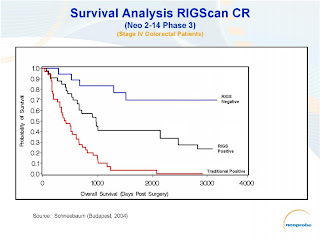
Top line (blue) - patients who had ALL tumorous tissue removed with RIGS
Middle line (black) - patients who had some cancerous tissue remaining outside the tumor
Bottom line (red) - patients who were treated with the traditional method (surgeon removing the tissue they located using their eyes and fingers)
After four years, about 70% of the RIGS treated patients were alive. Less than 6% of the traditionally treated patients were still alive.
Looks good, right? Common sense says RIGS definitely has a survival benefit, right? Well.... only to people with common sense. The FDA says they still want a formal study. The EMEA (the European version of our FDA) followed suit and asked for the same formal study.
So that's where it is right now. NEOP is gearing up to do that last survival study... RIGS is coming back to life. The EMEA just approved the study design, and NEOP is meeting with the FDA this summer (2009) to harmonize the design of this same trial design.
After the FDA approves the trial design Neoprobe will probably get a development partner who will fund the estimated cost of $25-$30 million. Neoprobe would then "split the pie" with them. But that's okay. Remember, Neoprobe is a tiny company. They could use a deep pocketed partner to finance the final survival study, manage the trial and deal with the EMEA & FDA. Plus, being a tiny company NEOP doesn't need much of the RIGS pie to have a HUGE impact on its bottom line.
But, remember 'OBSCURITY'? NEOP still lives there. Nobody knows that RIGS is coming back to life. Everyone wrote this company off when the FDA delayed the RIGS application.
That's important. 'Why'...? It's simple...
There are a lot of keys to making money. Hard work. Good contacts. Great work habits. Good education. Being smarter than the next guy. Luck. All of those are important...
But I'd trade them all in for one thing: Information!
If you get better information, and you get it sooner than everyone else, then you can make money. Think Gordon Gecko in Wall Street. Well... without the part at the end where Gordon heads off to jail.
Nobody knows that RIGS is coming back to life yet. Neoprobe slipped into obscurity. They aren't on anyone's radar screen. They've made some quiet announcements about RIGS waking up, but nobody is listening. So nobody knows what's happening.
Except me... and now you. Do with it what you will.
DDbuyer
Show Spelled Pronunciation [uhb-skyoor-i-tee] Show IPA Pronunciation
–noun, plural -ties.
1. the state or quality of being obscure.
2. the condition of being unknown.
3. uncertainty of meaning or expression; ambiguity.
4. an unknown or unimportant person or thing.
5. darkness; dimness; indistinctness.
6. NEOP (Okay - I added that one)
NEOP lives in obscurity. To be blunt, a lot of people don't know about this company. It's not that they don't know anything about its products... they simply don't know that it even exists... AT ALL...!
Why? For many reasons and, to be honest, many of them were valid at one time.
In the mid-1990's Neoprobe (NEOP) had a market cap of $350 million. The stock hit $22 a share. It was on the verge of financial success and the creation of many millionaires who had invested in it. Neoprobe developed a revolutionary new drug called RIGScan CR (RIGS). This is a new, patented drug and surgical process for patients who have developed colon cancer (remember Tony Snow?).
RIGS allows surgeons to use a radioactive tracer that binds to cancerous tissue, so they can locate and remove all of the cancerous tumor tissue. Right now surgeons still use their eyes and fingers to feel around and locate cancerous tissue (Hopefully!).
Every cancer patient who undergoes surgery to remove a tumor always ask the same question afterward:
"Did you get it all...?"
Why is it important? Because if the surgeon doesn't get it all, then the cancer springs up again and resumes spreading. Getting ALL of the tumor is critically important (if you want to live).
RIGS proved in clinical trials that it is the first diagnostic drug ever that can help the surgeon get it all, rendering the patient tumor free.
However...... the FDA, in all its bureaucratic wisdom, somehow didn't grasp the simple concept that 'no tumor = better outcome'. When all of the clinical trials were finished after years of testing at a cost of $100 million, the FDA asked for more information.
The FDA asked NEOP to go back to the drawing board and give them ANOTHER study documenting how much longer RIGS patients lived. The problem was that the little company was out of money. Like many small drug companies, every dime had been spent reaching that point. There was nothing left. So, the stock crashed and the company almost faded away... with a valid, life-saving drug shelved forever.
Long story made short... over the next eight years NEOP survived by diversifying into a line of new Gamma hardware products and started developing a second drug (Lymphoseek). However, most of the patients from the original RIGS clinical trials had also survived. Researchers were able to track down many of those patients and tally their survival rates. The results were most impressive.
One of the participating primary physicians compiled the data from the patient base, and charted them. Below is that chart.
(Click on image to enlarge)

Top line (blue) - patients who had ALL tumorous tissue removed with RIGS
Middle line (black) - patients who had some cancerous tissue remaining outside the tumor
Bottom line (red) - patients who were treated with the traditional method (surgeon removing the tissue they located using their eyes and fingers)
After four years, about 70% of the RIGS treated patients were alive. Less than 6% of the traditionally treated patients were still alive.
Looks good, right? Common sense says RIGS definitely has a survival benefit, right? Well.... only to people with common sense. The FDA says they still want a formal study. The EMEA (the European version of our FDA) followed suit and asked for the same formal study.
So that's where it is right now. NEOP is gearing up to do that last survival study... RIGS is coming back to life. The EMEA just approved the study design, and NEOP is meeting with the FDA this summer (2009) to harmonize the design of this same trial design.
After the FDA approves the trial design Neoprobe will probably get a development partner who will fund the estimated cost of $25-$30 million. Neoprobe would then "split the pie" with them. But that's okay. Remember, Neoprobe is a tiny company. They could use a deep pocketed partner to finance the final survival study, manage the trial and deal with the EMEA & FDA. Plus, being a tiny company NEOP doesn't need much of the RIGS pie to have a HUGE impact on its bottom line.
But, remember 'OBSCURITY'? NEOP still lives there. Nobody knows that RIGS is coming back to life. Everyone wrote this company off when the FDA delayed the RIGS application.
That's important. 'Why'...? It's simple...
There are a lot of keys to making money. Hard work. Good contacts. Great work habits. Good education. Being smarter than the next guy. Luck. All of those are important...
But I'd trade them all in for one thing: Information!
If you get better information, and you get it sooner than everyone else, then you can make money. Think Gordon Gecko in Wall Street. Well... without the part at the end where Gordon heads off to jail.
Nobody knows that RIGS is coming back to life yet. Neoprobe slipped into obscurity. They aren't on anyone's radar screen. They've made some quiet announcements about RIGS waking up, but nobody is listening. So nobody knows what's happening.
Except me... and now you. Do with it what you will.
DDbuyer


Subscribe to:
Posts (Atom)